









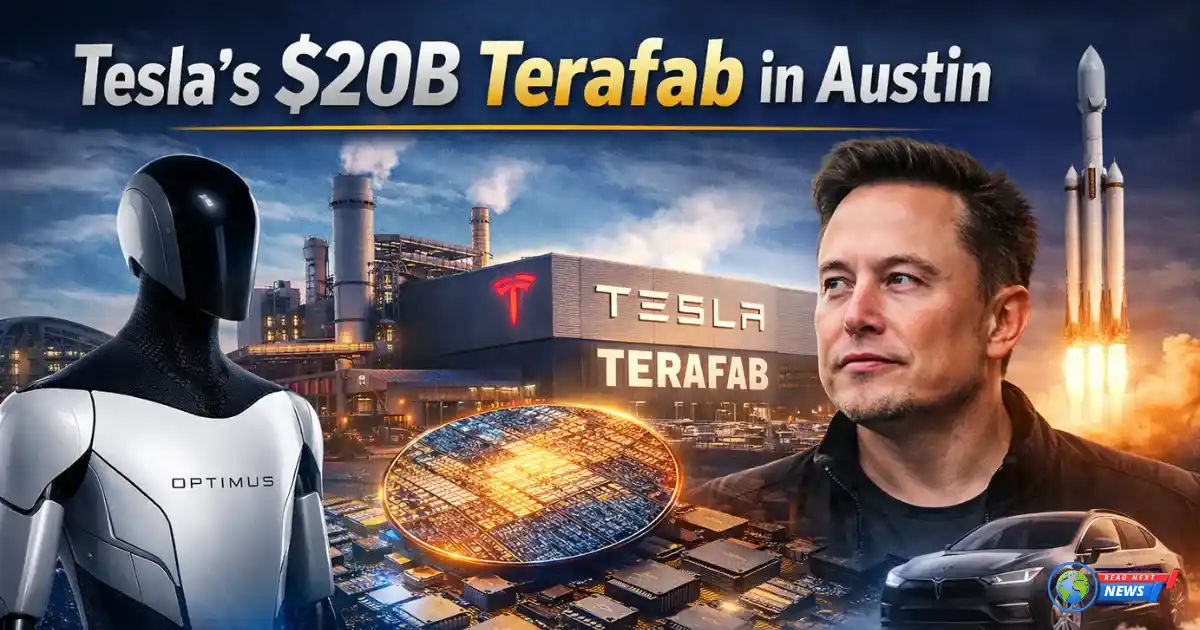
Tesla is taking a massive leap into the semiconductor world as CEO Elon Musk announces a $20 billion “Terafab” chip manufacturing plant in Austin, Texas. This bold move signals Tesla’s transition from an electric vehicle company into a full-scale AI and robotics powerhouse.
The Terafab facility will be built on Tesla’s campus in eastern Travis County and is expected to produce 100 million to 200 million AI chips annually, addressing one of Tesla’s biggest challenges: chip supply constraints.
Why Tesla Needs 200 Million Chips
Tesla’s long-term vision goes far beyond cars. The company is aggressively expanding into “physical AI,” including:
- Self-driving robo-taxis
- The humanoid robot Optimus
- Advanced AI computing systems
According to analysts, if Tesla reaches its ambitious production targets for Optimus—potentially 100 million units per year—it would require over 200 million chips annually, more than 50 times its current demand.
The Supply Problem Tesla Must Solve
The global semiconductor shortage has already shown how fragile supply chains can be. Tesla currently relies on external partners like:
- Samsung Electronics (AI chips manufacturing)
- Other global chip suppliers
However, even the best-case production output from suppliers won’t meet Tesla’s future needs, according to Musk.
This is why Terafab is critical—it allows Tesla to:
- Gain self-reliance in chip production
- Avoid supply bottlenecks
- Scale AI products faster
What Makes Terafab So Ambitious
The Terafab isn’t just another chip plant—it’s designed to be one of the most powerful fabrication systems ever built.
Key highlights:
- $20 billion investment
- Up to 1 terawatt of compute production annually
- Covers logic, memory, and packaging in one ecosystem
- Supports AI across vehicles, robots, and even space tech
Musk noted that all existing global fabs combined only meet about 2% of his long-term chip needs.
A Joint Venture or Tesla Solo?
There’s still debate over how Tesla will fund and operate Terafab.
Possible approaches include:
- Partnership model (similar to Tesla’s past collaboration with Panasonic)
- Solo investment, with strategic chip partners
Reports suggest the project may involve collaboration between:
- Tesla
- SpaceX
- xAI
This would create a unified ecosystem powering everything from cars to rockets.
Tesla’s Shift: From EVs to AI Dominance
Tesla’s stock valuation increasingly reflects its AI ambitions rather than just EV sales.
Despite slowing electric vehicle growth, investors remain optimistic because:
- AI and robotics offer massive future revenue potential
- Terafab could remove the biggest scaling limitation: chips
- Tesla is positioning itself as a vertically integrated AI leader
Final Thoughts
Tesla’s Terafab project is more than just a factory—it’s a strategic move to control the future of AI hardware.
If successful, it could:
- Eliminate reliance on external chip suppliers
- Accelerate the rollout of Optimus robots and robo-taxis
- Redefine Tesla as a global AI infrastructure company
In simple terms, Tesla isn’t just building cars anymore—it’s building the brain behind the machines of the future.