










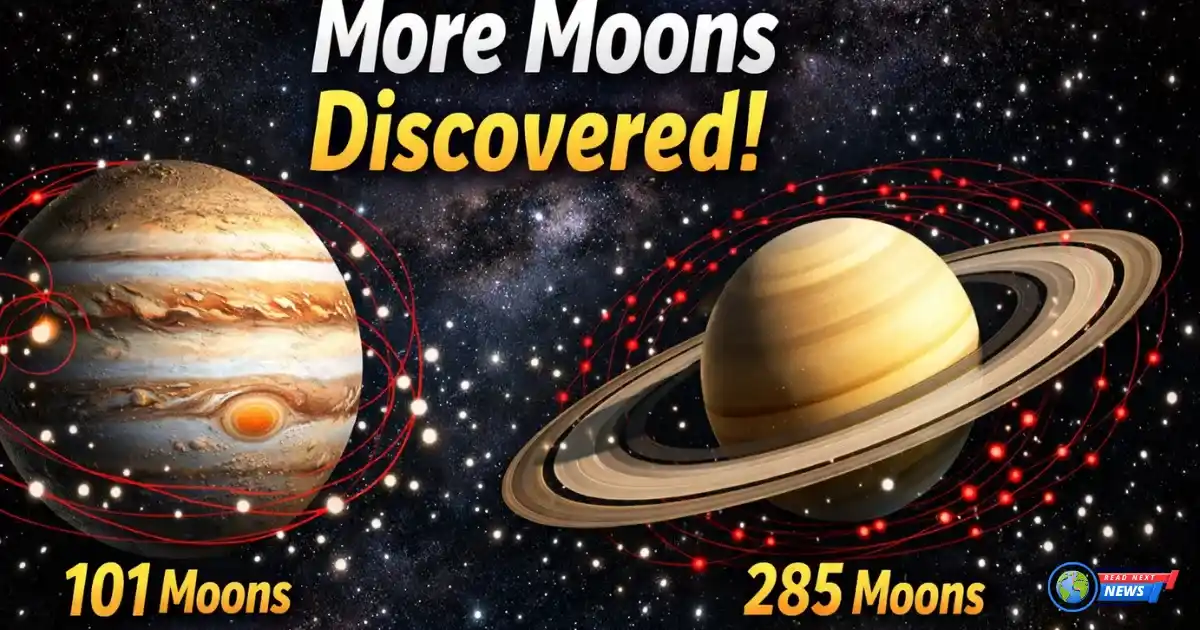
Astronomers have discovered 15 new moons orbiting Jupiter and Saturn, pushing the total number of known moons in our solar system to new heights. The announcement was made on March 16, 2026, by the Minor Planet Center, the global authority for cataloging small celestial bodies.
With these latest findings, Saturn now boasts an impressive 285 confirmed moons, while Jupiter has crossed a major milestone with 101 moons.
Tiny, Faint, and Hard to Detect
The newly discovered moons are extremely small, measuring roughly 2 miles (3 kilometers) in diameter. Their faint brightness—ranging between magnitude 25 and 27—makes them incredibly difficult to observe.
For comparison, Earth’s moon shines at about magnitude -12.6, highlighting just how dim these newly found objects are. Their distant and wide orbits around their parent planets further complicate detection.
How Astronomers Found Them
Scientists identified these moons by combining older telescope data with new observations, tracking faint objects that showed consistent motion across the sky.
Major observatories played a key role, including:
- The Magellan–Baade Telescope in Chile
- The Subaru Telescope in Hawaii
- The Canada–France–Hawaii Telescope
Additionally, the Vera C. Rubin Observatory has been instrumental in spotting subtle changes in the night sky. Since becoming operational in 2025, it has generated hundreds of thousands of alerts, helping astronomers detect moving objects more efficiently.
Why Saturn Has So Many Moons
Saturn continues to dominate as the planet with the most moons in the solar system. Its vast gravitational influence and complex ring system make it a natural hub for capturing small celestial objects.
Interestingly, many of Saturn’s moons are spread across enormous distances—so wide that their total span would appear several times larger than Earth’s moon in the sky.
Naming the New Moons
Most of the newly discovered moons won’t receive official names anytime soon. According to the International Astronomical Union, only moons with significant scientific importance are typically named.
Instead, these moons are currently identified using technical designations such as:
- Jupiter: S/2011 J 4, S/2018 J 5, S/2024 J 1
- Saturn: S/2020 S 45 through S/2023 S 57
A Growing Moon Count Across the Solar System
With these discoveries, the total number of known moons orbiting planets and dwarf planets has reached over 440.
Here’s the current breakdown:
- Earth: 1 moon
- Mars: 2 moons
- Jupiter: 101 moons
- Saturn: 285 moons
- Uranus: 28 moons
- Neptune: 16 moons
Dwarf planets like Pluto also contribute to the count, with five known moons.
More Discoveries Expected
Astronomers believe this is just the beginning. As telescope technology improves and observation methods become more advanced, many more moons are expected to be discovered—especially around gas giants like Jupiter and Saturn.
Upcoming missions to Jupiter’s system in the early 2030s could also reveal additional satellites and provide deeper insights into these distant worlds.
Final Thoughts
The discovery of new moons around Jupiter and Saturn highlights how rapidly our understanding of the solar system is evolving. What once seemed like a fixed cosmic inventory is now constantly expanding.
As scientists continue scanning the skies, one thing is clear: the solar system still holds many secrets waiting to be uncovered.